Paylaş
 [/av_promobox]
Irish ecofeminism activist V’cenza Cirefice: The female body is seen as a resource. The system does this to nature, does this to women, does this to indigenous communities. It does this to anyone it sees as an object.
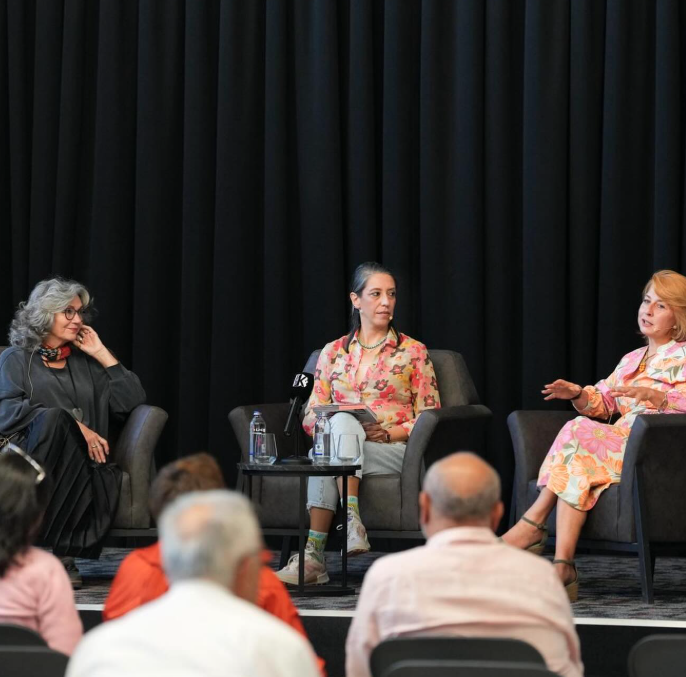
Within the events organized as part of the 23rd Uçan Süpürge International Women’s Film Festival held this year, we conducted an interview with Irish ecofeminism activist V’cenza Cirefice.
The interview we conducted with the facilitation of the Festival’s International Relations Coordinator Dicle Kızılkan gains much greater significance at this time when the Istanbul Convention is being opened to debate.
***
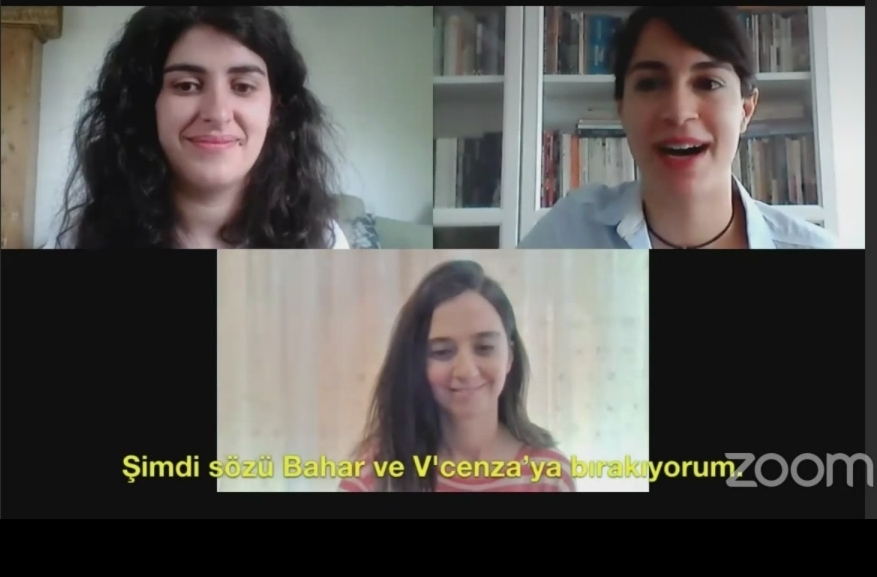
Dicle Kızılkan: Hello everyone from the Uçan Süpürge International Women’s Film Festival. First, I would like to introduce our colleagues. V’cenza Cirefice is an Irish ecofeminist and a member of an ecofeminist collective there. She is the coordinator of an activist group called Fossil Free NI. V’cenza is doing her PhD on women and extractivism in Ireland. Bahar Topçu is a ballet teacher and climate activist. She defines herself as green and feminist. Now I’m giving the floor to Bahar and V’cenza.
Bahar Topçu: Thank you Dicle. Hello again V’cenza. You say that women are at the forefront of environmental struggles. We can say this is also true for Turkey. In current debates in academic work on feminism and activism practices, ecofeminism is increasingly taking a more important place.
First, could you please explain why and how you choose to define yourself as an ecofeminist? How did you connect with its theory, daily practices, and activism?
V’cenza Cirefice: I think I always saw myself as both an environmentalist and a feminist. But my integration of these two and their theories happened when I started my undergraduate studies and began reading about ecofeminism. I remember a light bulb going off in my head when I read a paragraph about ecofeminism. It really helped me understand how different oppressions and struggles are interconnected, woven together. Then I understood that ecofeminism essentially identifies the roots of many problems like sexism and racism in oppressive systems such as capitalism, colonialism, and patriarchy. While this isn’t new for feminism, what ecofeminism does is include non-human nature in the oppressed class as well. That’s what I love about it.
This entire worldview, approaching events and the world with a systematic perspective, has also influenced me as an activist. I’m fortunate that I’m also doing my academic research on ecofeminism. I also joined the ecofeminist collective that Dicle mentioned. It’s truly a wonderful community. Many marches, workshops, and events are organized. Other feminist collectives in Ireland are the same way. For example, the Galway feminist collective, while not explicitly ecofeminist, really understands the connection between environmental justice and gender justice. The activist movements I’m part of that take a structural approach to events are like this. A really beautiful aspect of ecofeminism is that while it’s an academic phenomenon, it’s closely related to collective movements and changing the oppressive structures that got us into this mess. Being in these groups gives me feelings of commitment and solidarity.
‘Cultural and material ecofeminism’
B.T: I want to discuss with you ecofeminism’s approach to our relationship with nature. Some criticisms say that ecofeminism is quite essentialist because calling the planet mother earth and associating women with nature’s fertility is indeed essentialist. Another criticism is that it remains outside political struggle. What do you think? How do you approach these criticisms as someone from within the movement?
V.C: Let’s start with the essentialism issue. This is a very important topic to discuss when talking about ecofeminism. I’m really glad you brought this up. Many ecofeminists have received harsh criticism for being essentialist, and I think this is actually a very accurate criticism. But like feminism, ecofeminism also has many different branches. It can be divided into two broad wings: Cultural ecofeminism and more material ecofeminism.
The cultural wing is very essentialist and I don’t really like following this wing. This wing, developed by American white middle-class women in the 80s and 90s, draws a special, cosmological and spiritual connection between women and nature. It talks a lot about worshipping mother earth and goddesses. I think politically, this creates quite a problem because it often appropriates indigenous cultures without participating in their struggles. It also implies that all women are in the same category, that there’s no difference between them, and completely erases other gender varieties. It’s like saying “To be a woman, you must be this way.”
‘Women have a more material connection with the environment’
The branch I include myself in more is material ecofeminism. This branch says that nature and women are categories constructed by society. The root of the connection between women and nature is actually in capitalist, patriarchal production and in these systems imposing the worst effects of environmental degradation and climate change on women. And their relationship with the environment is connected to gender roles. It’s also related to the gendered division of labor. Because women do most of the care and reproductive work, they have a more material connection with the environment.
I think it’s important not to dismiss an entire movement just because part of it is essentialist. I think it can really offer good understanding. Especially regarding intersectionality. Since Black feminist Kimberle Crenshaw developed this concept, ecofeminism became one of the first movements to talk about intersectionality. It was also one of the first movements to discuss how race, class, ethnicity, sexuality, gender, and environment are related and intersect with each other.
B.T: In 2018, Ireland brought the repeal of the 8th Amendment, which banned abortion in the Constitution, to referendum, and those who argued that abortion is a human right won with a 60% vote rate. How did you feel? How did ecofeminists become part of the abortion rights movement?
C.V: Actually, I’m happy to talk about this. Because this was a huge moment for Ireland. This was proof that grassroots activism works. As well as the efforts of feminist organizations in Ireland for 30 years. I had the privilege of being part of the pro-choice group as Ireland headed to the referendum. It was incredible. I was living abroad the year of the referendum, but I was able to participate in solidarity movements from afar. It was beautiful to see many Irish people living abroad participating in solidarity from all over the world.
Looking at the referendum from an ecofeminist perspective… Many different types of feminist groups were organizing on this issue. This was the most important issue for the period leading up to the referendum. The ecofeminist community in Dublin was also very active. They were campaigning, going door to door, collecting donations, participating in marches. They were talking to politicians.
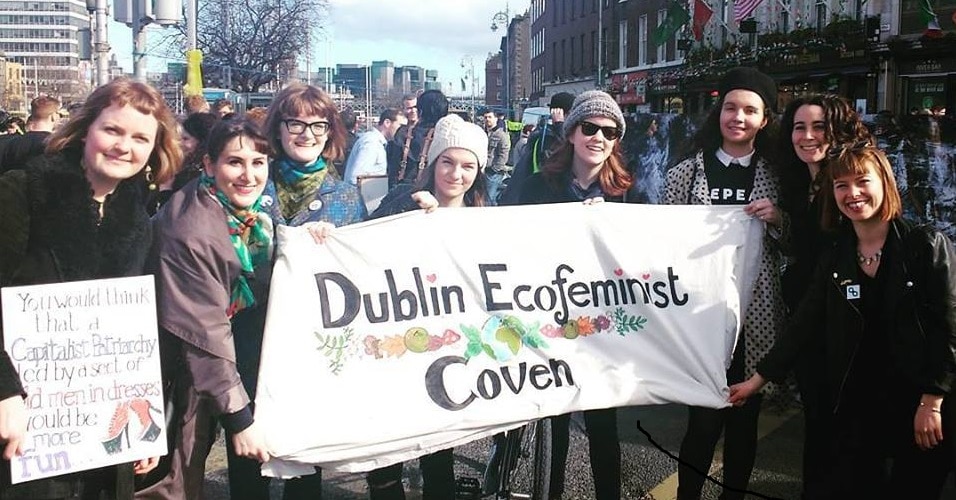
March for abortion rights in Dublin
‘The female body is seen as a resource’
From an ecofeminist perspective… The groups I was part of really understood that reproductive justice is connected to environmental justice. Because they took a systematic approach. How they understood this, or how I understand it… Oppressive systems like colonialism, patriarchy, and capitalism depend on creating concepts of “us” and “others”. The self is active and in control. And others are seen as a resource to be controlled, exploited, and dominated. The system does this to nature, does this to women, does this to indigenous communities. It does this to anyone it sees as an object. In this case, I think the female body is seen as a resource. To be brought into line and controlled, to produce the labor force needed for the system to continue. To ensure capitalism continues. This is definitely a dehumanizing worldview. This is connected to how the system treats nature. It’s seen as a free resource to be used as much as possible. I also see reproductive justice as much more than the physical act of giving birth. Reproductive acts are life-sustaining acts. True reproductive justice includes housing, a clean environment, economic and social welfare. So actually, everything is interconnected.
B.T: What you said about the female body reminded me of a quote from Vandana Shiva. She says that patriarchy and modern medicine work together to devalue the female body. With your words, these really clicked in my mind.
Along with this, I also want to discuss this in terms of the climate justice movement. Intersectionality works mutually in the patriarchy and climate denialism we’re fighting against. Women fighting on the front lines for climate justice can find white and wealthy men who otherize them in front of them. They deny the climate crisis in parallel with women’s rights. The solidarity between the climate movement and the feminist movement is naturally developing as well.
What do you think about this? Because we’re somehow facing all this hatred and criticism together, aren’t we?
C.V: Yes, absolutely. Young people and women are at the forefront of the struggle against climate change. I’m fortunate to have interned at WECAN (Women’s Earth and Climate Action Network). They document and highlight women who are at the forefront of the struggle against climate change all over the world. I think the reason so many women are at the forefront of this struggle is not an essentialist connection that women are more sensitive to the environment. I think the system doesn’t work well for these human groups. They’re already being exploited and facing the worst effects of the neoliberal system. When you face many oppressions in your own life, seeing the oppression done to nature becomes easier in many ways. But I think it varies according to context. I think it’s important to see that things like age, class, ethnicity, sexuality also affect these. If we need to give an example of the hostility women face… Indigenous women, non-white women face the triple threat of colonialism, capitalism, and patriarchy on a global scale. Sexual violence, death threats… Even slower types of violence: The consumption of livelihoods like water systems, the lands they depend on for survival… I think the entire system that creates climate change stems from patriarchy, the capitalism and colonialism it’s connected to. And the patriarchal side of the system reacts to activists who go against acceptable gender roles in this patriarchal worldview. Activists stand out, speak without hesitation, and openly resist. This is unacceptable to the system. Because as you said, it challenges many different parts of the system.
‘Feminist perspective is important’
I think what feminism can bring to the climate movement is really wonderful. It offers the idea that this isn’t an environmental arrangement that exists independently from society, on the sidelines. We’re also talking about social justice. For example, most grassroots organizations around the world are run by women. Especially by non-white women and indigenous women. But as you go up, in more mainstream NGOs, administrations, institutions, we see that the majority are Western white men. That’s why it’s important to have a feminist perspective that constantly draws attention to this situation.
One of my favorite aspects of feminist approaches to climate movements is that they point to the systematic roots of the crisis. Neoliberal approaches dependent on individual lifestyle changes are not sufficient. It’s the system itself that needs to change. For example, if you’re talking about changing domestic consumption practices but not opposing the gendered division of labor within the household, you’ll only be copying the system we already have. And you’ll continue it. Saying that technological fixes or solutions are available in the market will leave these unequal power relations as they are. So it doesn’t actually address the root of the crisis. It allows oppression and exploitation to continue. I find it amazing that feminists prioritize and show different solutions that challenge sexism and racism. They look at the crisis in a different, deeper way.
B.T: I want to make a small addition to what you said. According to many studies, women are the first to be affected by the impacts of climate change. Whether they’re in the Northern or Southern Hemisphere doesn’t change anything. Women at every level are affected by the impacts of climate change. In contrast, when we look at those who cause climate change, as you said, in the system and among decision-makers, men and women are not equal in number. The cause of climate change is mostly the patriarchal fossil fuel approach that we encounter. What you said really says very important things about a feminist approach to this crisis.
V.C: We have a wonderful podcast by two Irish ecofeminists called “Mothers of Invention.” Their slogan: “Climate change is male-caused; a problem with feminist solutions.” I think this really sums up the situation.
B.T: Yes, it does. Now we need more feminists in the field. Both men and women.
V.C: Yes, absolutely, people of all genders.
B.T: Yes, yes.
Now we can move on to the pandemic. Since Covid-19 spread and some sanctions were implemented by governments, what has changed and what hasn’t changed in your life? Do you still have the chance to be active in those communities and activist groups? And can you tell us how you relate to each other in this online world?
V.C: Yes, of course. I was actually surprised and pleased by the closeness that these online platforms provided. It was wonderful, I was able to participate in online meetings. I also presented online workshops. In fact, just yesterday we presented a workshop, it was very nice. I’m also part of a communication network called Active Hope. Here, we look at our inner response to the crisis we see in the world. So it’s very relevant to the times we’re in. We’ve organized many online workshops to support activists right now. They were also very nice. And it was really inspiring to see the ecofeminist community and NN actively participating in and producing joint projects.
I think this is also the purpose of ecofeminism. To transition from an individualistic, competitive society to a society based on empathy and solidarity. Seeing this kind of transition actually happen is truly extraordinary. That’s why building communities is so important for activism. In times like these, they support you, which is very nice. We use this opportunity to invite indigenous speakers, or women from the Southern Hemisphere. Without the internet, these people couldn’t be at our meetings. So being able to give voice to voices we normally wouldn’t hear is a great opportunity.
B.T: What a beautiful collaboration, thank you. It was exciting to hear ecofeminism approaches from you.
V.C: Thank you.